AUD/USD Signals: Free Aussie Dollar Trade Alerts
AUD/USD, known as the Aussie, links the Australian dollar with the US dollar and is closely tied to commodities, China and global growth.


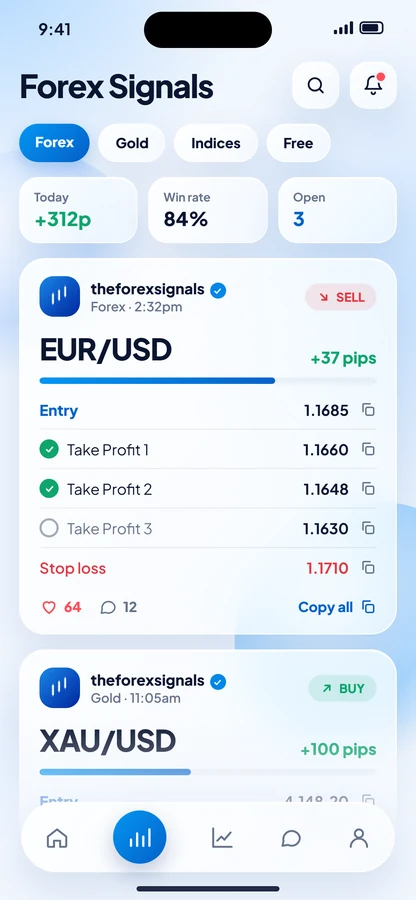
How a AUD/USD signal looks
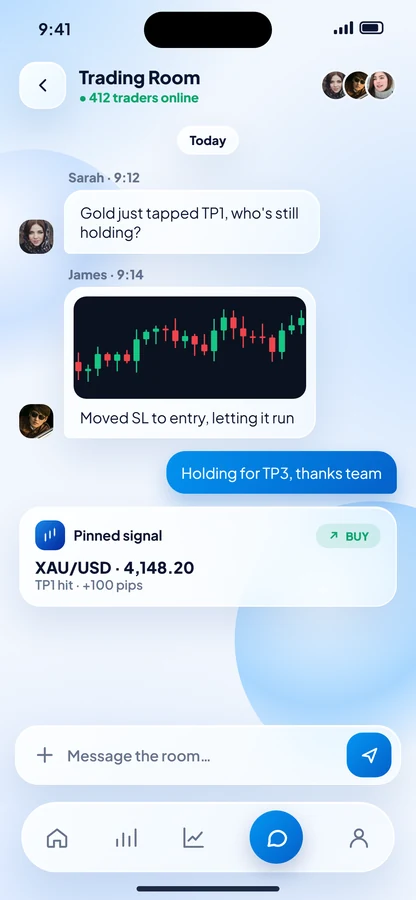
Entry, stop loss and three take profits. You get an alert as each target is hit.
- Signal postedLevels arrive instantly in the app.
- Place the tradeSize it with the lot size calculator.
- Follow the alertsTP1, TP2 and TP3 updates in real time.
Illustrative example only, not a real or past signal. Real signals are posted live in the app with the same layout.
AUD/USD Signals: the essentials
What is AUD/USD?
AUD/USD shows how many US dollars one Australian dollar buys. The Australian dollar is the base currency and the US dollar is the quote currency, so a rising price means the Aussie is strengthening. It is one of the major currency pairs and is popularly called the Aussie.
Australia is a large exporter of iron ore, coal, gas and gold, and China is its biggest trading partner. As a result, AUD/USD is often described as a commodity currency pair and a proxy for global growth. When the world economy looks healthy and commodity prices rise, the Aussie usually performs well. That clear link to the bigger picture makes it a useful pair to include in our forex signals.
What drives AUD/USD
Reserve Bank of Australia and the Fed
Interest rate decisions and statements from the Reserve Bank of Australia (RBA) and the US Federal Reserve set the tone. Expectations of higher Australian rates support the Aussie, while a firmer Fed tends to push AUD/USD down.
Commodities and China
Iron ore and copper prices, along with Chinese data such as GDP, industrial production, PMIs and trade figures, can move AUD/USD noticeably. Strong Chinese demand is generally good news for the Australian dollar.
Best times to trade AUD/USD (UK time)
| Session | UK time | What to expect |
|---|---|---|
| Sydney and Tokyo | 22:00-08:00 | Australian and Chinese data, RBA decisions |
| London | 08:00-13:00 | Follow-through or reversal of Asian moves |
| London/New York overlap | 13:00-17:00 | US data at 13:30, strong dollar moves |
| New York afternoon | 17:00-22:00 | Slower, driven by risk sentiment |
Australian data is usually released between about 00:30 and 02:30 UK time. Our AUD/USD signals are mostly sent during London and New York hours, with occasional setups after important Asian-session news.
Volatility and pip value on AUD/USD
AUD/USD typically moves 50 to 90 pips a day, making it one of the calmer major pairs outside news events. That suits traders who prefer moderate stops and steady trends.
One pip on a standard lot is worth $10, a mini lot about $1 and a micro lot about $0.10. In pounds that is a little under £8 per pip on a standard lot, depending on the GBP/USD rate. Our pip calculator shows the exact value for your account currency and trade size.
How our AUD/USD signals look
Each AUD/USD signal includes everything you need in one message:
- Pair and direction: AUD/USD BUY or SELL
- Entry: where to open the trade
- Stop loss: where the idea is invalid
- TP1, TP2, TP3: three take profit levels
Illustrative example: an AUD/USD signal walk-through
This is an illustrative example to explain how a signal is used. It is not a real signal or a past result.
Suppose strong Chinese data and rising iron ore prices lift the Aussie, and AUD/USD breaks above resistance in the London session. A signal might read: AUD/USD BUY at 0.6600, stop loss 0.6570, TP1 0.6620, TP2 0.6640, TP3 0.6670.
Frequently asked questions
Australia exports large amounts of iron ore, coal, gas and gold, so demand for those commodities affects demand for the Australian dollar. When commodity prices rise, especially on strong Chinese demand, the Aussie often strengthens.
Yes. The Forex Signals app is completely free for everyone, with no subscriptions or paid tiers.
Most Australian data, including employment and inflation figures, is released between about 00:30 and 02:30 UK time, depending on daylight saving. RBA interest rate decisions are also announced during the Asian session.
In normal conditions AUD/USD usually moves around 50 to 90 pips a day. The range can be larger on RBA decision days, major Chinese data releases and big US numbers such as Non-Farm Payrolls.
There is often a positive relationship because Australia is a major gold producer and both tend to rise when the US dollar weakens. However, the correlation is not reliable all the time.
Yes. All forex trading carries a high level of risk and you can lose money.