
EUR/USD Signals: Free Alerts on the Most Traded Pair
EUR/USD is the most traded currency pair on the planet, with the tightest spreads and the deepest liquidity in forex.


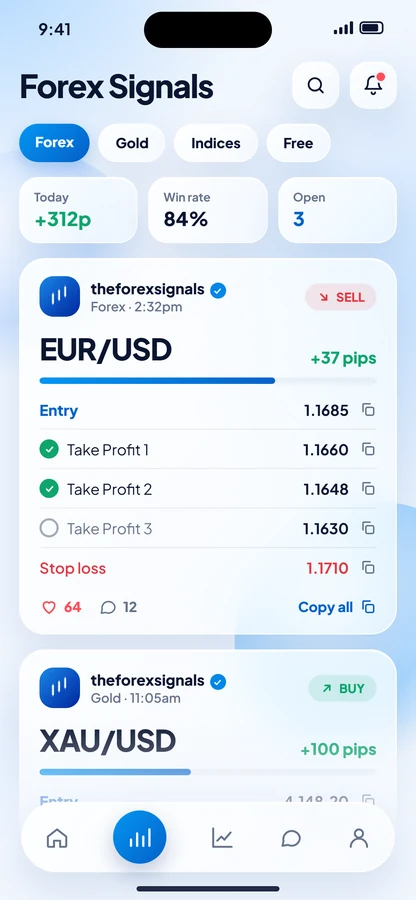
How a EUR/USD signal looks
Entry, stop loss and three take profits. You get an alert as each target is hit.
- Signal postedLevels arrive instantly in the app.
- Place the tradeSize it with the lot size calculator.
- Follow the alertsTP1, TP2 and TP3 updates in real time.
Illustrative example only, not a real or past signal. Real signals are posted live in the app with the same layout.
EUR/USD Signals: the essentials
What is EUR/USD?
EUR/USD tells you how many US dollars one euro is worth. The euro is the base currency and the dollar is the quote currency, so a rising price means the euro is gaining and a falling price means the dollar is strengthening. Traders often call the pair Fiber, a nod to GBP/USD's nickname Cable and the modern fibre-optic lines that carry prices today.
It pairs the two largest economic blocs in the world, the eurozone and the United States, and accounts for more daily volume than any other currency pair. For traders this means very low spreads, smooth price action and reliable technical levels, which is why EUR/USD features regularly in our forex signals and is often the first pair beginners learn to trade.
What drives EUR/USD
Because EUR/USD is so liquid, it tends to respond to the big picture rather than small news items. These are the forces that matter most.
ECB versus the Federal Reserve
The gap between European Central Bank and Federal Reserve interest rates, and where traders think it is heading, is the single biggest driver of the pair. Watch ECB press conferences and Fed meetings closely; both can move EUR/USD by 100 pips or more.
Best times to trade EUR/USD (UK time)
EUR/USD trades 24 hours a day from Monday to Friday, but it is not equally active all day. The best opportunities usually come when European and US traders are both at their desks.
| Session | UK time | Typical behaviour |
|---|---|---|
| Asian | 23:00-07:00 | Slow, narrow ranges |
| Frankfurt and London open | 07:00-10:00 | Volume returns, Eurozone data released |
| London/New York overlap | 13:00-17:00 | Peak liquidity, US data at 13:30 |
| US afternoon | 17:00-21:00 | Quieter, occasional Fed headlines |
Volatility and pip value on EUR/USD
EUR/USD is calmer than pairs like GBP/USD or GBP/JPY, usually moving 60 to 90 pips a day in normal conditions. That steadier behaviour makes it a good fit for beginners and for traders who prefer tighter stops.
One pip on a standard lot is worth $10, a mini lot about $1 and a micro lot about $0.10. In pounds that works out at a little under £8 per pip on a standard lot, depending on the GBP/USD rate. Check the exact figure for your own position with our pip calculator.
How our EUR/USD signals are structured
Every EUR/USD signal follows a clear, consistent layout so you can copy it into your trading platform quickly:
- Pair and direction: EUR/USD BUY or SELL
- Entry price: where to open the trade
- Stop loss: where the setup is invalid and the trade closes
- TP1, TP2 and TP3: staged profit targets
Illustrative example: reading a EUR/USD signal
This is an illustrative example to show the format only. It is not a real signal or a past result.
Imagine the ECB sounds more cautious than expected and EUR/USD rejects a resistance level during the London session. A signal could look like this: EUR/USD SELL at 1.0850, stop loss 1.0880, TP1 1.0830, TP2 1.0810, TP3 1.0780.
Frequently asked questions
EUR/USD is often recommended for beginners because it has the tightest spreads, deep liquidity and generally steadier price action than more volatile pairs.
No. The Forex Signals app is completely free for everyone.
Most EUR/USD signals are sent between around 07:00 and 17:00 UK time, covering the Frankfurt and London opens and the London and New York overlap. These are the hours with the most volume and the tightest spreads.
In normal conditions EUR/USD typically moves somewhere between 60 and 90 pips a day. The range can be much larger around ECB or Fed decisions and major US data such as Non-Farm Payrolls.
Both pairs are priced against the US dollar, so any big change in dollar strength tends to move them in the same direction. That correlation means opening the same trade on both pairs can double your exposure.
Yes. Forex trading carries a high level of risk and losses are a normal part of it.