USD/JPY Signals: Free Dollar-Yen Trade Alerts
USD/JPY is the second most traded currency pair in the world and the main way traders express a view on the US dollar against the Japanese yen.


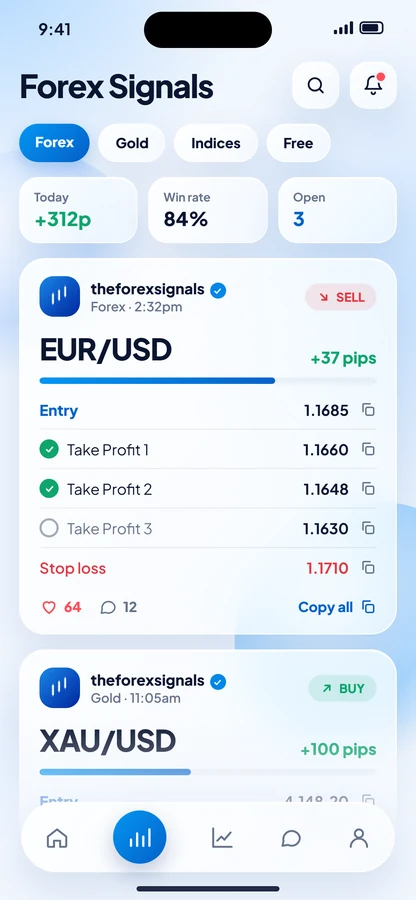
How a USD/JPY signal looks
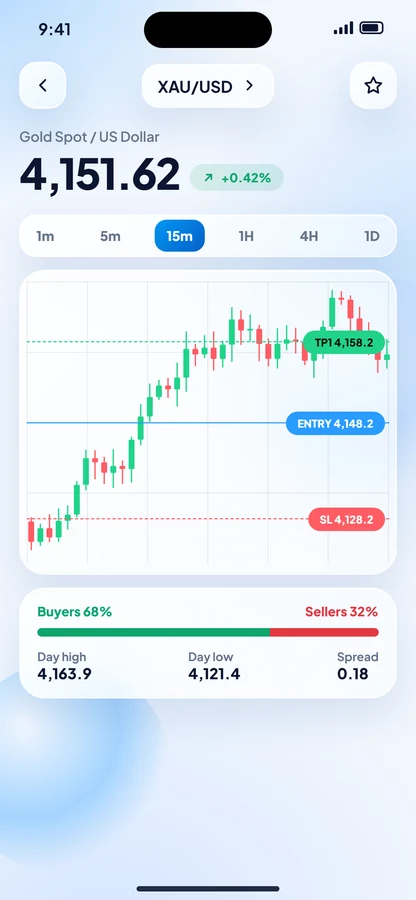
Entry, stop loss and three take profits. You get an alert as each target is hit.
- Signal postedLevels arrive instantly in the app.
- Place the tradeSize it with the lot size calculator.
- Follow the alertsTP1, TP2 and TP3 updates in real time.
Illustrative example only, not a real or past signal. Real signals are posted live in the app with the same layout.
USD/JPY Signals: the essentials
What is USD/JPY?
USD/JPY shows how many Japanese yen one US dollar buys. The dollar is the base currency and the yen is the quote currency, so a rising price means the dollar is strengthening and a falling price means the yen is gaining. The pair is sometimes called the Gopher or simply the dollar-yen.
After EUR/USD, it is the most actively traded currency pair, offering deep liquidity and tight spreads. It reflects the relationship between the world's largest economy and Japan, a major exporter whose currency is widely used as a funding and safe-haven currency. That mix gives USD/JPY a distinctive personality and makes it a regular feature of our forex signals.
What drives USD/JPY
Interest rate differentials
More than almost any other pair, USD/JPY follows the gap between US and Japanese interest rates. When US Treasury yields rise relative to Japanese yields, the dollar usually climbs against the yen. Falling US yields tend to pull the pair lower.
Federal Reserve and Bank of Japan policy
Fed decisions, the dot plot and comments from Fed officials matter on the US side. On the Japanese side, any sign that the Bank of Japan is moving away from very low rates or adjusting bond yield controls can cause large moves.
Best times to trade USD/JPY (UK time)
| Session | UK time | What to expect |
|---|---|---|
| Tokyo | 00:00-08:00 | Japanese data and BoJ headlines, active for a yen pair |
| London | 08:00-13:00 | Steady volume, follow-through on Asian moves |
| London/New York overlap | 13:00-17:00 | US data at 13:30, often the biggest moves |
| New York afternoon | 17:00-21:00 | Moves driven by US yields and Fed comments |
Unlike many pairs, USD/JPY can be lively during the Asian session. Most of our USD/JPY signals are still sent during London and New York hours, when spreads are tightest.
Volatility and pip value on USD/JPY
USD/JPY usually moves 70 to 120 pips a day, sitting between the calm of EUR/USD and the wild swings of GBP/JPY. It is known for long, steady trends driven by yields, punctuated by sharp drops when risk sentiment sours or intervention hits.
As a yen pair, one pip is the second decimal place (150.20 to 150.21). On a standard lot a pip is worth 1,000 yen, about $6.50-$7 or roughly £5-£5.50 depending on the exchange rate. Check the exact value for your position with our pip calculator.
Reading the US yield link before a USD/JPY trade
Because USD/JPY tracks interest rate expectations so closely, our analysts keep an eye on the US 10-year Treasury yield alongside the chart. When yields and USD/JPY are moving in the same direction, a trend-following signal has stronger backing. When they diverge, for example yields falling while USD/JPY is still rising, it can be an early warning that the move is running out of steam.
You do not need to watch bond markets yourself to use our USD/JPY signals, but understanding the link helps explain why a signal has been sent.
How our USD/JPY signals look
Every USD/JPY signal uses the same simple layout:
- Pair and direction: USD/JPY BUY or SELL
- Entry: where to open the trade
- Stop loss: where the setup is invalid
- TP1, TP2, TP3: staged take profit levels
Frequently asked questions
The biggest driver is the gap between US and Japanese interest rates, often tracked through US Treasury yields.
Yes. The Forex Signals app is completely free for everyone, with no paid plans or subscriptions.
On a standard lot, one pip on USD/JPY is worth 1,000 Japanese yen. Depending on the exchange rate, that is around $6.50 to $7, or roughly £5 to £5.50.
Intervention is when a government or central bank buys or sells its own currency to influence the exchange rate. Japan has bought yen at times to slow its decline, causing USD/JPY to fall hundreds of pips in minutes.
Most USD/JPY signals are sent during the London session and the London and New York overlap, roughly 08:00 to 17:00 UK time, when spreads are tight and US data is released.
Yes, like all forex trading it carries a high level of risk and you can lose money. No signal is guaranteed.