
EUR/JPY Signals: Free Euro-Yen Trade Alerts
EUR/JPY is one of the most popular cross pairs in forex, combining the euro's steady liquidity with the yen's sensitivity to global risk.


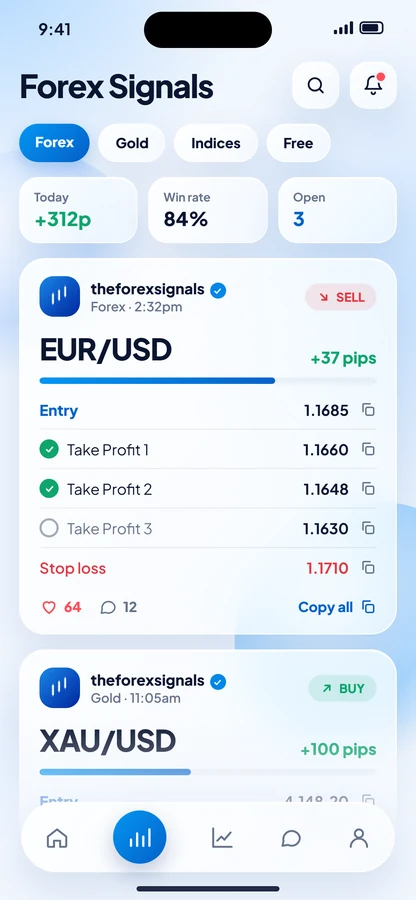
How a EUR/JPY signal looks
Entry, stop loss and three take profits. You get an alert as each target is hit.
- Signal postedLevels arrive instantly in the app.
- Place the tradeSize it with the lot size calculator.
- Follow the alertsTP1, TP2 and TP3 updates in real time.

Illustrative example only, not a real or past signal. Real signals are posted live in the app with the same layout.
EUR/JPY Signals: the essentials
What is EUR/JPY?
EUR/JPY shows how many Japanese yen one euro buys. It is a cross pair with no US dollar involved, and its price is effectively EUR/USD multiplied by USD/JPY. When the price rises the euro is strengthening against the yen; when it falls the yen is gaining.
Sometimes nicknamed the Yuppy or simply the euro-yen, it is the most traded yen cross after GBP/JPY in many retail markets. It tends to trend well, reacts clearly to changes in risk appetite and usually has tighter spreads than GBP/JPY, which makes it a useful pair for traders who want yen exposure with slightly less volatility. It appears regularly in our forex signals.
What moves EUR/JPY
ECB and Bank of Japan policy
The interest rate gap between the eurozone and Japan is a core driver. A more hawkish European Central Bank tends to lift EUR/JPY, while any move by the Bank of Japan towards higher rates can pull it sharply lower.
Global risk sentiment
Like other yen crosses, EUR/JPY is a classic risk barometer. When stock markets are rising and investors are confident, the yen often weakens and EUR/JPY climbs. During sell-offs the yen is bought as a safe haven and the pair can drop quickly.
Best times to trade EUR/JPY (UK time)
| Session | UK time | What to expect |
|---|---|---|
| Tokyo | 00:00-07:00 | Yen-driven moves, moderate ranges |
| European open | 07:00-12:00 | Euro and yen both active, often the cleanest trends |
| London/New York overlap | 13:00-17:00 | Volatility from US data and risk sentiment |
| Late session | 17:00-23:00 | Thinner liquidity |
Most of our EUR/JPY signals are sent during the European morning and early afternoon, when both currencies are well traded.
Volatility and pip value on EUR/JPY
EUR/JPY usually moves 90 to 140 pips a day, more than EUR/USD but generally less than GBP/JPY. That gives decent opportunity with stops that are manageable for most account sizes.
As a yen pair, one pip is the second decimal place (162.40 to 162.41). On a standard lot it is worth 1,000 yen, roughly £5-£5.50 depending on the exchange rate. Mini and micro lots scale that down by ten and a hundred times. Use the pip calculator for the exact value in your account currency.
How our EUR/JPY signals look
Every EUR/JPY signal follows the same structure:
- Pair and direction: EUR/JPY BUY or SELL
- Entry: the price to open
- Stop loss: the level that invalidates the setup
- TP1, TP2, TP3: three targets to take profit in stages
Illustrative example: a EUR/JPY signal step by step
This is an illustrative example to explain the format. It is not a real signal or a past result.
Imagine global markets turn risk-off and EUR/JPY breaks below a support level during the European morning. A signal could read: EUR/JPY SELL at 162.40, stop loss 162.90, TP1 162.05, TP2 161.70, TP3 161.20.
Frequently asked questions
Both are yen crosses that react strongly to global risk sentiment, but GBP/JPY is usually more volatile because the pound tends to move more than the euro.
Yes. The Forex Signals app is completely free for everyone.
The European morning, roughly 07:00 to 12:00 UK time, is often the most reliable period because both the euro and the yen are actively traded. The London and New York overlap can also bring strong moves, especially when US data shifts global risk sentiment.
On a standard lot, one pip on EUR/JPY is worth 1,000 yen, which is about £5 to £5.50 depending on the exchange rate. A mini lot is about a tenth of that and a micro lot a hundredth.
The Japanese yen is traditionally seen as a safe-haven currency. When investors become nervous and sell riskier assets such as shares, they often buy yen, which pushes yen crosses like EUR/JPY lower.
Yes. Forex trading carries a high level of risk and losing trades are inevitable.